


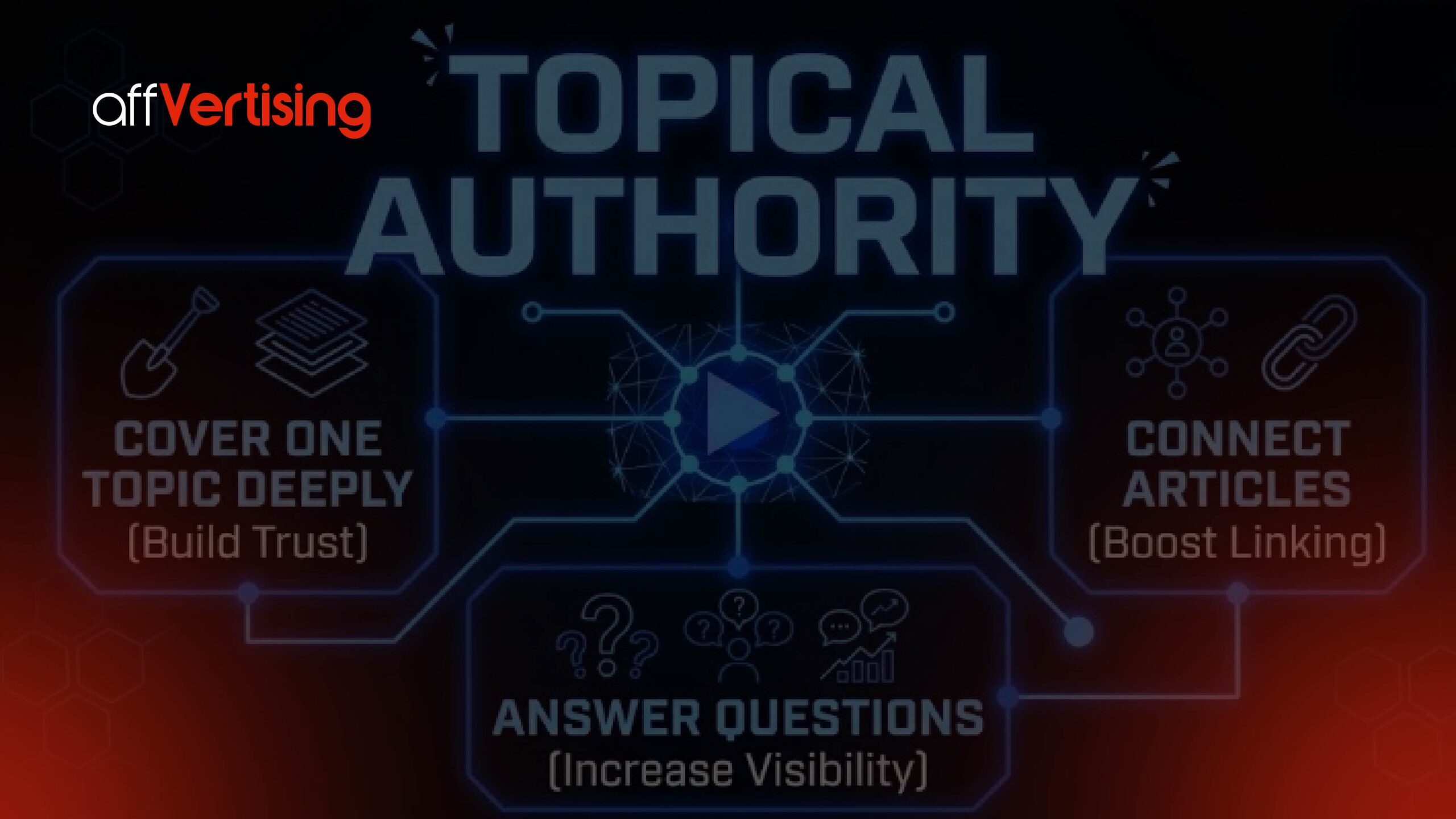
What Is an Affiliate Topical Authority Building Strategy?
An affiliate topical authority building strategy is a systematic approach to becoming a trusted source of information within a specific niche by creating comprehensive, interconnected content that covers all relevant topics, subtopics, and user questions. The goal is to establish expertise, improve visibility, increase audience trust, and generate sustainable affiliate revenue through complete subject coverage.
Why Is Topical Authority Important in Affiliate Marketing?
Topical authority helps affiliate websites demonstrate expertise across an entire subject area rather than relying on isolated articles. When a website consistently publishes comprehensive content covering all aspects of a niche, it becomes a more valuable resource for users and earns greater trust.
A strong authority position also improves content discoverability, increases user engagement, strengthens internal linking opportunities, and supports long-term organic traffic growth.
Key Benefits of Topical Authority
- Increased trust and credibility
- Higher content visibility
- Improved affiliate conversion rates
- Stronger internal content ecosystem
- Better audience retention
- Sustainable traffic growth
- Reduced dependence on individual articles
What Is Topical Authority in Affiliate Marketing?
Topical authority refers to the depth and breadth of expertise demonstrated across a specific niche through comprehensive content coverage.
Topical Authority Definition
A website achieves topical authority when it consistently publishes accurate, detailed, and interconnected content that answers most user questions within a particular subject area.
Example
A website focusing on VPN affiliate marketing should cover:
- VPN reviews
- VPN comparisons
- VPN setup guides
- VPN troubleshooting
- VPN security concepts
- VPN protocols
- VPN pricing
- VPN alternatives
- VPN use cases
- VPN industry news
Covering only product reviews is insufficient for establishing complete authority.
What Are the Core Components of a Topical Authority Strategy?
Building authority requires multiple interconnected elements.
Core Authority Components
| Component | Purpose |
|---|---|
| Pillar Content | Main topic coverage |
| Cluster Content | Supporting topics |
| Internal Linking | Content relationships |
| Entity Coverage | Subject completeness |
| User Intent Mapping | Audience alignment |
| Content Updates | Freshness maintenance |
| Expertise Signals | Credibility building |
| Performance Analysis | Growth measurement |
How Do Pillar Pages Support Topical Authority?
Pillar pages serve as comprehensive resources that cover broad topics and connect to supporting content.
Characteristics of Effective Pillar Content
- Covers major aspects of a topic
- Targets broad keywords
- Links to supporting articles
- Serves as a central information hub
- Provides complete topic overviews
Example Pillar Topic
“Affiliate Marketing”
Supporting clusters may include:
- Affiliate programs
- Affiliate networks
- Affiliate tracking
- Affiliate commissions
- Affiliate SEO
- Affiliate content writing
- Affiliate conversion optimization
What Are Topic Clusters?
Topic clusters are groups of related content connected to a central pillar page.
Topic Cluster Definition
A topic cluster is a collection of supporting articles that explore specific subtopics in greater detail while linking back to a primary resource.
Example Affiliate Cluster
Pillar Topic:
Affiliate Marketing
Supporting Articles:
- Best Affiliate Programs
- Affiliate Commission Models
- Affiliate Cookies Explained
- Affiliate Tracking Methods
- Affiliate Disclosure Requirements
- Affiliate Content Strategies
- Affiliate Funnel Optimization
Together these articles create a complete knowledge ecosystem.
How Should User Intent Be Mapped?
User intent determines what information readers seek at different stages of their journey.
Main Intent Categories
Informational Intent
Users seek knowledge.
Examples:
- What is affiliate marketing?
- How do affiliate links work?
Commercial Intent
Users evaluate options.
Examples:
- Best affiliate networks
- Affiliate software reviews
Comparison Intent
Users compare alternatives.
Examples:
- ShareASale vs CJ
- Impact vs PartnerStack
Transactional Intent
Users are ready to act.
Examples:
- Join affiliate programs
- Apply to affiliate networks
A complete authority strategy addresses every intent category.
What Entities Should Be Covered in an Affiliate Niche?
Entities are important concepts, tools, platforms, metrics, and strategies connected to a topic.
Primary Affiliate Entities
- Affiliate marketing
- Affiliate programs
- Affiliate networks
- Affiliate links
- Affiliate commissions
- Tracking software
- Conversion rates
- Cookie duration
- EPC
- CPA
- CPS
- Revenue sharing
Supporting Entities
- SEO
- Content marketing
- Email marketing
- Funnel optimization
- Analytics
- Attribution models
- Audience targeting
- Landing pages
Authority increases as entity coverage expands.
How Does Internal Linking Strengthen Authority?
Internal linking connects related content and helps users discover additional information.
Internal Linking Benefits
- Improves content discovery
- Enhances topic relationships
- Supports user navigation
- Distributes authority across pages
- Increases engagement metrics
Example Structure
Affiliate Marketing Guide
Links to:
- Affiliate Networks
- Affiliate Tracking
- Affiliate Programs
- Affiliate SEO
- Affiliate Funnels
Each supporting page links back to the pillar page.
What Content Types Build Topical Authority?
Different content formats serve different informational needs.
Essential Content Types
Beginner Guides
Introduce foundational concepts.
Tutorials
Provide step-by-step instructions.
Comparisons
Help users evaluate options.
Reviews
Analyze products and services.
Case Studies
Demonstrate practical applications.
Glossary Articles
Define important industry terms.
Statistics Pages
Provide industry data.
Expert Roundups
- Offer specialized insights.
- Combining multiple formats creates broader authority.
How Can Content Gaps Be Identified?
Content gap analysis reveals missing topics that should be covered.
Content Gap Process
- Identify main topic.
- List subtopics.
- Analyze competitor coverage.
- Compare existing content.
- Create missing articles.
- Build internal links.
Example
If a website covers VPN reviews but lacks VPN setup guides, security concepts, and protocol explanations, significant authority gaps remain.
What KPIs Measure Topical Authority Growth?
Authority should be measured using objective metrics.
Important KPIs
| KPI | Purpose |
|---|---|
| Organic Traffic | Visibility growth |
| Ranking Keywords | Topic coverage |
| Click-Through Rate | Search engagement |
| Time on Page | Content quality |
| Pages Per Session | Content exploration |
| Conversion Rate | Revenue impact |
| Backlinks | Authority signals |
| Returning Visitors | Audience loyalty |
What Is a Topical Authority Content Framework?
A structured framework ensures complete niche coverage.
5-Level Authority Model
Level 1: Pillar Topics
Broad industry subjects.
Level 2: Core Clusters
Major subtopics.
Level 3: Supporting Articles
Detailed explanations.
Level 4: Comparison Content
Alternative evaluations.
Level 5: Commercial Content
- Revenue-generating pages.
- This structure creates a comprehensive knowledge ecosystem.
How Can Topical Authority Be Scaled?
Authority growth requires systematic expansion.
Scaling Process
Phase 1
Build foundational pillar content.
Phase 2
Publish supporting clusters.
Phase 3
Create comparison content.
Phase 4
Add case studies and examples.
Phase 5
Expand into adjacent topics.
Phase 6
- Update existing content regularly.
- Scaling should prioritize depth before breadth.
What Common Mistakes Prevent Authority Growth?
Many affiliate websites struggle because they focus on isolated content.
Common Mistakes
- Publishing random articles
- Ignoring topic clusters
- Weak internal linking
- Insufficient entity coverage
- Neglecting informational content
- Failing to update old content
- Overemphasizing commercial pages
Authority requires complete ecosystem development.
What Tools Support Topical Authority Building?
Several tools assist with content planning and analysis.
Research Tools
- Ahrefs
- Semrush
- Google Trends
- AnswerThePublic
Analytics Tools
- Google Analytics
- Google Search Console
- Microsoft Clarity
Content Planning Tools
- Notion
- Airtable
- Trello
Internal Linking Tools
- Link Whisper
- Screaming Frog
These tools help identify opportunities and monitor progress.
What Future Trends Will Influence Topical Authority?
The future of authority building focuses on deeper subject expertise and comprehensive knowledge coverage.
Emerging Trends
Entity-Based Search
Search systems increasingly understand relationships between concepts.
Semantic Understanding
Content quality depends on contextual relevance.
Knowledge Graph Expansion
Topic relationships become more important.
User Experience Signals
Engagement metrics gain influence.
Expertise Verification
- Demonstrable expertise becomes increasingly valuable.
- Websites with complete topic ecosystems will maintain stronger competitive positions.
How Should an Affiliate Authority Strategy Be Implemented?
Implementation should follow a structured roadmap.
Step-by-Step Process
- Select a niche.
- Identify pillar topics.
- Build topic clusters.
- Map user intent.
- Create comprehensive content.
- Connect content through internal links.
- Fill content gaps.
- Monitor KPIs.
- Update existing articles.
- Expand into related topics.
Consistent execution is more important than rapid content production.
Master Framework Summary
Follow this 10-step authority-building system:
- Choose a focused niche.
- Create pillar content.
- Build topic clusters.
- Cover all major entities.
- Address every search intent.
- Strengthen internal linking.
- Publish multiple content formats.
- Monitor authority KPIs.
- Update content regularly.
- Expand strategically into adjacent topics.
Affiliate Topical Authority Building Checklist
- ✓ Niche selected
- ✓ Pillar pages created
- ✓ Topic clusters mapped
- ✓ Entity coverage completed
- ✓ User intent analysis performed
- ✓ Internal linking structure established
- ✓ Supporting content published
- ✓ Content gaps identified
- ✓ KPI tracking implemented
- ✓ Existing content updated
- ✓ Authority expansion plan created
- ✓ Conversion opportunities integrated
Expert Insight
The strongest affiliate websites do not win by publishing more content; they win by covering topics more completely. A website that thoroughly addresses every major question, concept, comparison, use case, and related entity within a niche creates a knowledge ecosystem that attracts users throughout the entire decision-making journey. This comprehensive coverage becomes a long-term competitive advantage that is difficult for smaller or less organized competitors to replicate.
Frequently Asked Questions (FAQs)
What is topical authority in affiliate marketing?
Topical authority is the demonstrated expertise and comprehensive coverage of a specific niche through interconnected, high-quality content that answers user questions and addresses related topics.
Why is topical authority important for affiliate websites?
It improves credibility, increases traffic opportunities, strengthens audience trust, and supports higher affiliate conversions through comprehensive topic coverage.
How long does it take to build topical authority?
Most websites require several months to over a year of consistent publishing and optimization before establishing strong authority within a competitive niche.
What is a topic cluster?
A topic cluster is a group of related articles connected to a central pillar page that collectively cover a broader subject area in depth.
What are pillar pages?
Pillar pages are comprehensive resources that cover broad topics and link to supporting articles that provide deeper explanations of specific subtopics.