


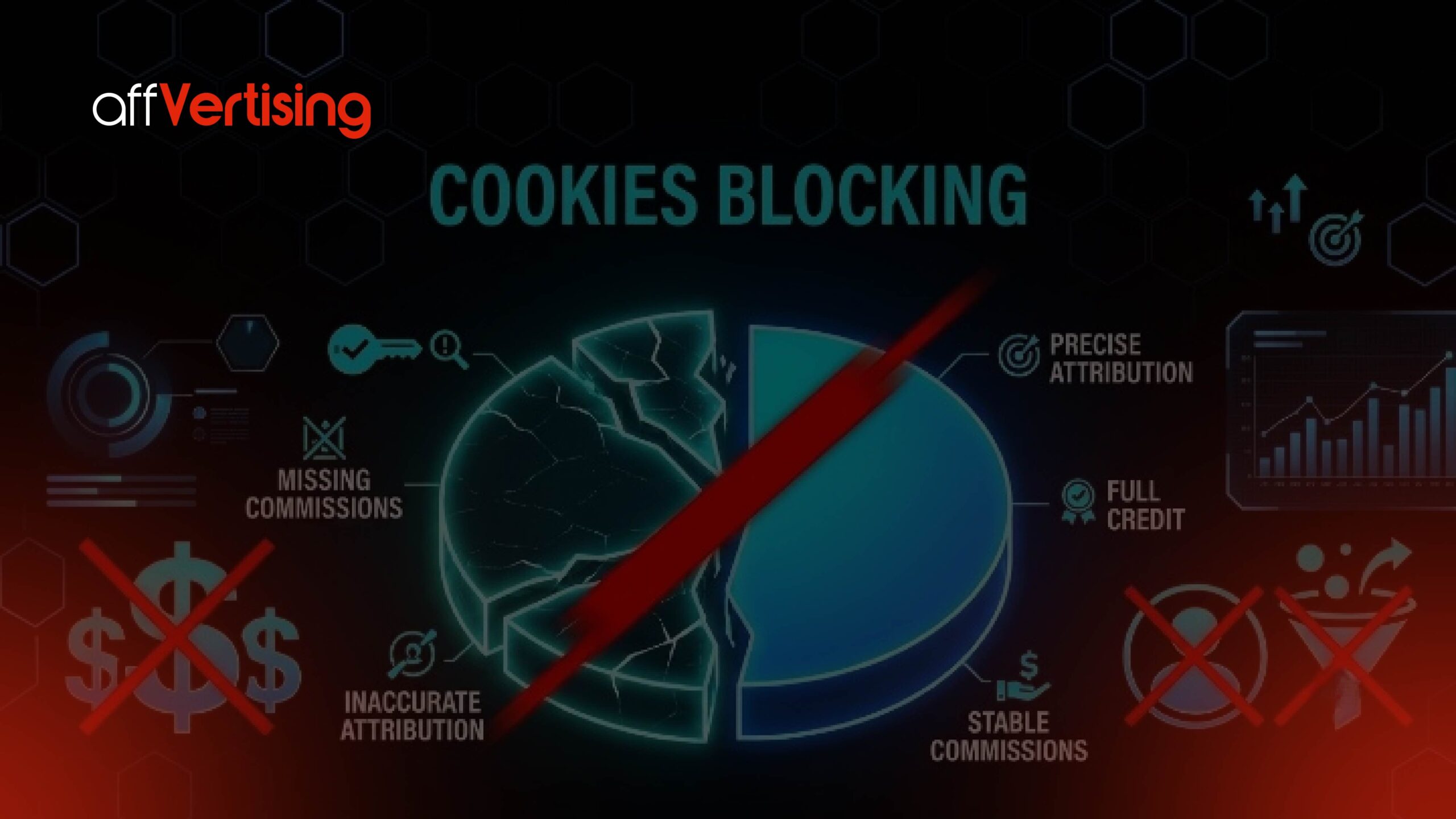
How Is Cookie Blocking Transforming Affiliate Marketing Revenue Models in 2026?
Cookie blocking is significantly reshaping affiliate marketing by restricting third-party cookie tracking across browsers and devices. This disruption breaks traditional attribution paths, reduces conversion visibility, and forces the industry to shift toward server-side tracking, first-party data, and privacy-compliant measurement systems. As a result, revenue reporting, affiliate payouts, and performance optimization have become less deterministic and more probabilistic.
Why Is Cookie Blocking Becoming a Structural Shift in Affiliate Marketing?
Cookie blocking is no longer a technical inconvenience; it is a structural change in how digital attribution works. Affiliate marketing historically depended on browser-based cookies to track user journeys from click to conversion. However, privacy-first architecture, regulatory pressure, and browser-level enforcement have fundamentally weakened this model.
Today, attribution is fragmented across multiple environments—mobile apps, browsers, logged-in ecosystems, and server-side systems. This fragmentation means affiliate marketers can no longer rely on a single tracking mechanism. Instead, they must integrate multiple data sources such as Conversion APIs, server logs, and identity-based tracking systems to reconstruct user journeys.
The most important shift is this: tracking is moving from the browser layer to the infrastructure layer, where data is collected and processed on controlled servers rather than user devices. This change increases accuracy potential but also raises implementation complexity, requiring advanced data engineering and compliance awareness.
What Is Cookie Blocking in Affiliate Marketing?
Cookie blocking is the restriction or deletion of browser cookies—especially third-party cookies—by browsers, extensions, or operating systems to limit cross-site user tracking.
It directly impacts affiliate systems by preventing tracking identifiers from persisting across domains, which breaks attribution between affiliate clicks and merchant conversions.
Key Entities:
- Cookies: Browser-stored data used for session tracking
- Third-party cookies: Cross-domain tracking identifiers
- Affiliate tracking systems: Platforms attributing conversions to partners
Why Is Cookie Blocking Increasing in Digital Ecosystems?
Cookie blocking is increasing due to a convergence of privacy regulations, browser policies, and consumer behavior shifts that prioritize data protection over advertising convenience.
1. Privacy Regulations and Legal Enforcement
Global regulations are enforcing stricter consent requirements for tracking user behavior.
- GDPR (General Data Protection Regulation) in Europe requires explicit consent before tracking cookies are stored.
- CCPA/CPRA (California Privacy Laws) give users the right to opt out of data selling and tracking.
- Similar laws are expanding globally, pushing platforms toward privacy-first design.
These regulations reduce the legal viability of unrestricted third-party tracking.
2. Browser-Level Policy Changes
Major browsers are actively restricting cookies as part of long-term privacy strategies.
- Safari (Apple) uses Intelligent Tracking Prevention (ITP), limiting cookie lifespan and blocking cross-site tracking.
- Firefox blocks third-party cookies by default using Enhanced Tracking Protection.
- Google Chrome is phasing out third-party cookies through the Privacy Sandbox initiative.
This means cookie blocking is now built into browser architecture—not just optional settings.
3. Rise of Ad Blockers and Privacy Extensions
Millions of users now install tools that automatically block tracking scripts.
- Ad blockers remove tracking pixels and scripts
- Privacy extensions block analytics and affiliate cookies
- Some tools simulate “clean sessions” every visit
This creates inconsistent tracking environments where affiliate links may work for some users but fail for others.
4. Consumer Awareness and Behavioral Change
Users are increasingly aware of digital tracking and actively limiting it.
- More users reject cookie consent banners
- Private browsing modes are widely used
- Mobile users prefer app-based ecosystems over open web tracking
This reduces the available dataset for affiliate attribution.
5. Shift Toward Platform-Owned Ecosystems
Large platforms are reducing reliance on third-party tracking in favor of internal systems.
- Google, Meta, Amazon prefer walled-garden analytics
- Logged-in environments reduce need for cookies
- First-party data ecosystems are prioritized
This centralization reduces the role of external affiliate tracking systems.
Impact Summary:
- Attribution windows are shrinking (30 days → 24–72 hours in many cases)
- Cross-domain tracking reliability is decreasing
- Unattributed conversions are increasing
- Affiliate commission disputes are rising
How Does Cookie Blocking Affect Affiliate Tracking Accuracy?
Cookie blocking directly reduces affiliate tracking accuracy by breaking the continuity of user journeys across websites and sessions. In traditional affiliate systems, cookies act as persistent identifiers that connect a user’s initial click on an affiliate link to their final conversion on a merchant’s website. When these cookies are blocked, deleted, or restricted by browsers or privacy tools, the tracking system loses the ability to recognize that both actions belong to the same user journey. As a result, attribution becomes incomplete, delayed, or entirely missing, leading to distorted performance data and unreliable reporting.
Core Effects:
- Loss of click-to-conversion linkage
- Underreported affiliate performance
- Misallocated commissions
- Broken multi-touch attribution chains
Cookie blocking also introduces a hidden layer of data fragmentation, where different parts of the same user journey are recorded in isolated systems without a shared identifier. This creates inconsistent analytics between affiliate networks, advertiser dashboards, and third-party analytics tools. Even when conversions occur successfully, they may be logged as “direct” or “organic” traffic instead of affiliate-driven, which distorts ROI calculations and weakens optimization decisions across campaigns.
Which Affiliate Marketing Entities Are Most Affected?
Affiliate Networks, merchants, affiliates, tracking pixels, and attribution models are all impacted by cookie blocking because it disrupts the shared tracking infrastructure that connects user clicks to conversions. When cookies are blocked, each entity in the affiliate ecosystem loses a different layer of visibility and control, resulting in fragmented reporting and reduced performance accuracy across the entire conversion funnel.
- Affiliate Networks: Lose tracking consistency across publishers and campaigns due to broken or incomplete click-to-conversion paths.
- Merchants: Lose accurate ROI visibility because conversions cannot be reliably traced back to specific affiliate sources.
- Affiliates: Lose commission attribution when valid traffic and sales are not properly recorded or credited.
- Tracking Pixels: Become unreliable in blocked or restricted environments, leading to missing or partial event capture.
- Attribution Models: Require redesign because traditional cookie-based logic fails under privacy-restricted tracking conditions.
How Do Modern Browsers Implement Cookie Blocking?
- Safari: Limits tracking via ITP
- Firefox: Blocks third-party cookies by default
- Chrome: Privacy Sandbox replaces cookies with cohort-based tracking
What Are the Major Tracking Breakpoints?
- Session discontinuity
- Cross-domain attribution failure
- Device-switch tracking loss
- Attribution window compression
What Are the Most Effective Solutions?
Affiliate tracking systems are shifting toward more resilient, privacy-compliant, and server-controlled solutions because cookie blocking has made browser-based attribution unreliable. The most effective approaches combine backend tracking, persistent first-party data, API-based conversion sharing, and structured URL parameters to rebuild accurate user journeys without depending on third-party cookies.
- Server-side tracking: Moves data collection from browser to backend servers, improving accuracy and bypassing ad blockers and cookie restrictions.
- First-party cookies: Stores tracking data under the same domain, making it more stable and compliant with privacy regulations.
- Conversion APIs (CAPI): Enables direct server-to-server data transfer for conversions, reducing dependency on browser tracking.
- UTM-based fallback tracking: Uses URL parameters to preserve source, campaign, and affiliate identifiers when cookies fail.
- Identity-based tracking systems: Uses logged-in user IDs, hashed emails, or customer profiles to connect user behavior across devices and sessions.
How Does Attribution Modeling Change?
Traditional deterministic models are replaced with hybrid and probabilistic models using machine learning and aggregated behavioral signals.
What Are the Key Metrics Impacted?
- Attribution accuracy rate
- Revenue leakage percentage
- Click-to-conversion match rate
- EPC volatility
What Are Common Mistakes?
- Over-reliance on last-click attribution
- No server-side tracking migration
- Weak UTM governance
- Ignoring privacy compliance changes
Tools & Technology Ecosystem
- GA4 (event-based analytics)
- Server-side tracking platforms
- Conversion APIs (Meta, Google)
- Customer Data Platforms (CDPs)
What Are Future Trends?
- AI-driven attribution modeling
- Identity-based tracking (email/hashed IDs)
- Full server-side data ecosystems
- Privacy Sandbox evolution
What Is the Scaling Framework?
- Level 1: Cookie-based tracking
- Level 2: Hybrid tracking (cookies + server-side)
- Level 3: Fully server-side + AI attribution
Final Expert Summary Framework
- Cookie blocking is a permanent structural shift
- Third-party cookies are being replaced by server-side systems
- Attribution is becoming probabilistic rather than deterministic
- First-party data is now the most reliable asset
- APIs and event-based systems define modern tracking
Implementation Checklist
- Deploy server-side tracking
- Enable first-party cookies
- Integrate Conversion APIs
- Standardize UTM tracking
- Adopt hybrid attribution model
- Monitor attribution loss
Expert Insight
The real transformation caused by cookie blocking is not just the loss of tracking—it is the redistribution of control over data. Earlier, browsers acted as neutral environments where marketers could observe user behavior through cookies. Now, control is shifting toward servers, platforms, and identity systems that own the data pipeline.
In this environment, the organizations that succeed are not those who collect the most clicks, but those who reconstruct the most complete user identity graph. This includes linking anonymous visits to known users through hashed identifiers, login events, and server-side behavioral stitching. Over time, affiliate marketing will evolve into a data engineering discipline where attribution is computed rather than observed.
Frequently Asked Questions (FAQs)
Why is cookie blocking increasing so rapidly?
Because privacy laws, browser restrictions, and user behavior collectively push the ecosystem away from third-party tracking.
How does cookie blocking affect affiliate revenue?
It reduces tracked conversions, leading to lower reported earnings and misattributed commissions.
Can affiliate tracking still work without cookies?
Yes, through server-side tracking, Conversion APIs, and first-party identity systems.
Which browsers are most restrictive?
Safari and Firefox lead in strict blocking, while Chrome is transitioning away from third-party cookies.
What is the best long-term solution?
A server-first tracking architecture combined with identity-based attribution systems.